What a hosting business needs from its tools
A hosting company or web agency with dozens of shared servers and hundreds of client sites cannot run maintenance from checklists and browser tabs. Someone has to see at a glance which server is running out of disk, which site is down, whose certificate is about to expire and which sites still run a PHP version past its end of life.
Updates are where things break. Each update needs a fresh backup, a check that the site still works and a quick way back if it does not. Alerts need thresholds and durations the team sets itself, plus quiet hours, so the on-call person is woken for a full disk and not for a short spike.
Clients want their own view of uptime, backups and invoices without seeing servers or other clients, and without emailing support to ask.
How the Kaitsija demo works
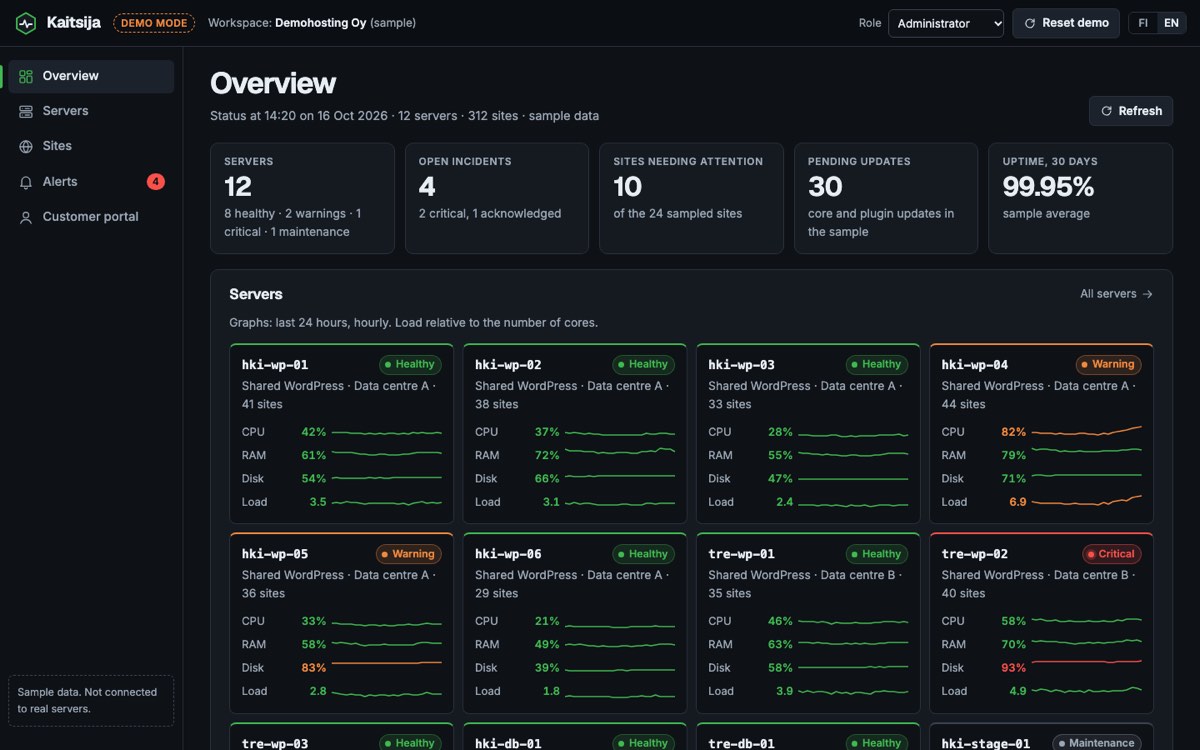
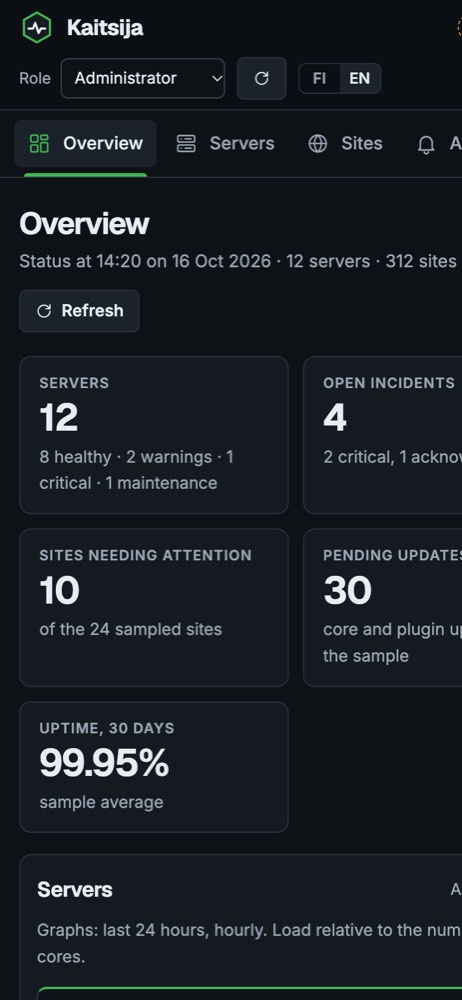
Kaitsija is a fictional product, made by Virtueinfo to show what we build, and every server, site and customer in it is sample data. The overview shows twelve servers with 24-hour graphs, open incidents and a hexagon map of sites by status. The servers screen adds filters, sorting and a detail drawer with graphs and the busiest processes.
The sites screen holds the signature feature. You select sites with pending updates and run them in bulk while a log shows each step: backup, update, health check. One sample site fails its check with an HTTP 500 on its checkout page, so Kaitsija restores the previous plugin version and checks the page again. The on-call role can follow updates but cannot start them.
On the alerts screen you acknowledge incidents, edit rules with validation, set quiet hours that hold warnings for a morning summary while critical alerts go out at once, and send a test alert to placeholder channels. The customer portal shows one client's uptime and backups, lets them simulate a restore after confirming, and lists invoices with the VAT worked out.
What a production build adds for a Finnish company
A live platform collects metrics from monitoring agents on your servers and works with your control panel, DNS, certificate and backup tools through their interfaces. Alerts go to real email, text message and chat channels, and invoices come from your billing system. Staff sign in with two-factor authentication, and clients can use strong electronic identification where you need it.
Security weighs more here than in most software, because the platform can change hundreds of client sites. We limit each role's rights, keep server credentials out of the browser, record every update, restore and rule change in an audit log, and handle client and invoice data in line with GDPR, with a data processing agreement and agreed retention times.
An admin panel manages customers, contracts and maintenance windows. The interface runs in Finnish and English, or Swedish, and works with a keyboard and a screen reader. After launch we look after security updates, backups and monitoring of the platform itself, and a dedicated team keeps developing it alongside your own operations staff.