What a ready-mix supplier needs from the software
Ready-mix concrete does not wait. Once a truck is loaded the concrete has limited time to reach the forms, and a pour stops if the next load is late. A supplier needs one schedule that the customer, the dispatch desk and the drivers all work from, instead of phone calls and paper slips.
The customer needs to order the right concrete for the site: strength, exposure and consistency class, discharge method and pour rate. The dispatcher needs to see every truck and pump across the day and spot clashes before trucks leave the plant. Drivers need directions and a delivery note on the phone, and the office needs delivered volumes for invoicing and reports.
How the Valuvuoro demo works
The signature logic is the delivery plan. Loads are planned for 8 m³ trucks, the arrival interval comes from the pour rate, and the truck cycle adds loading, driving, discharging, returning and washing out. Dividing the cycle by the interval gives the number of trucks that keeps the pour going. The order form and the dispatch board share this calculation, so customer and dispatcher see the same figures.
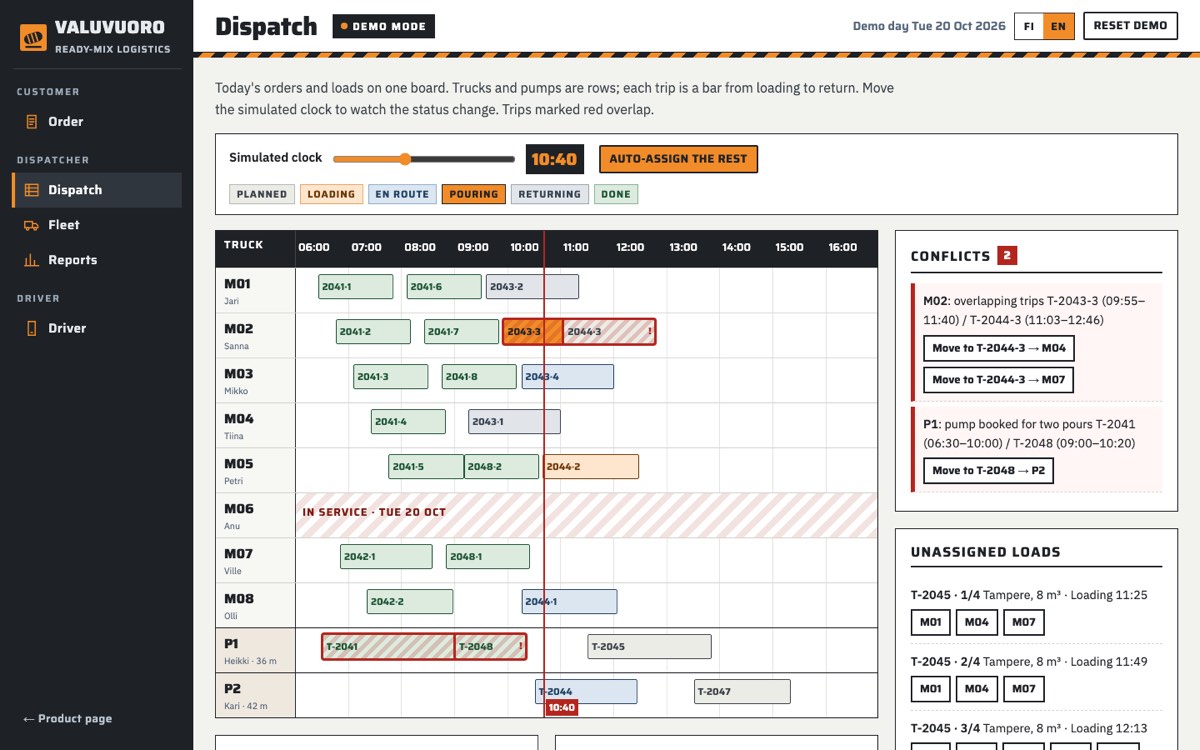
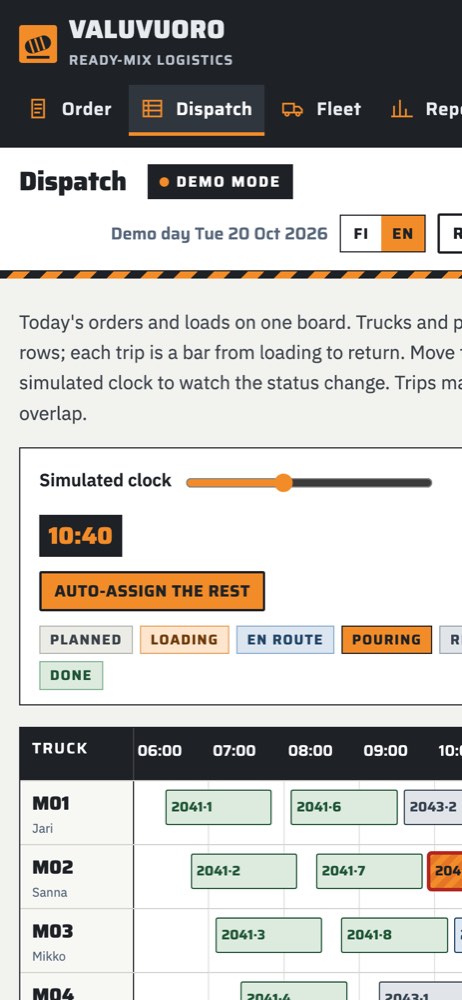
On the dispatch board, the day's orders are laid out by hour with trucks and pumps as rows. A simulated clock moves loads through loading, en route, pouring and returning. Overlapping trips and double-booked pumps turn red and offer a fix, and orders placed in the customer view appear on the board. A truck in the workshop cannot be assigned, and an XF exposure class reminds the customer about air-entrained concrete.
The driver view runs in the phone's browser with large buttons. The driver fills in the delivery note, records any water added and gets the receiver's signature with a finger or by name. Links to batching, invoicing and vehicle tracking appear as sample data only.
What a production build for a Finnish supplier adds
For a real supplier we connect the platform to the plant's batching system, so loading times and mixes come from the plant, to vehicle tracking for live positions, and to the invoicing or ERP system, so delivered volumes turn into invoices. Drive times come from your recorded trips instead of fixed assumptions, and several plants can share one board.
Contractors sign in with company accounts and roles, and administrators manage customers, sites, price lists, fleet and permissions. Strong electronic identification can be added where a sign-off must be tied to a person. Every change to an order or delivery note goes to an audit log, so disputes about times and volumes can be checked later.
Security and data protection are part of the build: encrypted connections, GDPR-compliant handling of driver and customer data, retention rules and backups. The service works in Finnish and English or Swedish, follows accessibility guidelines and uses analytics only after consent. A dedicated team of ours maintains it with updates, monitoring and support.